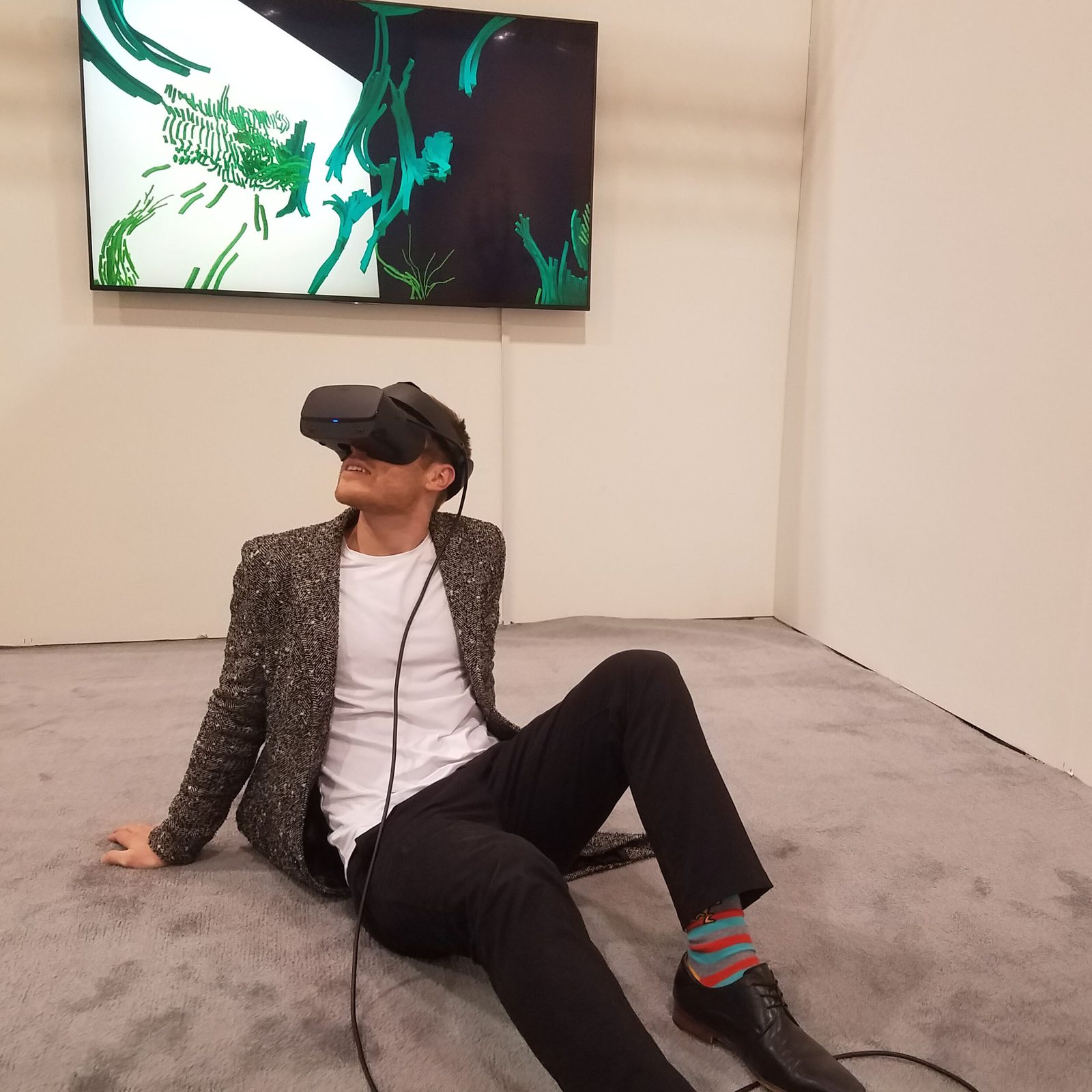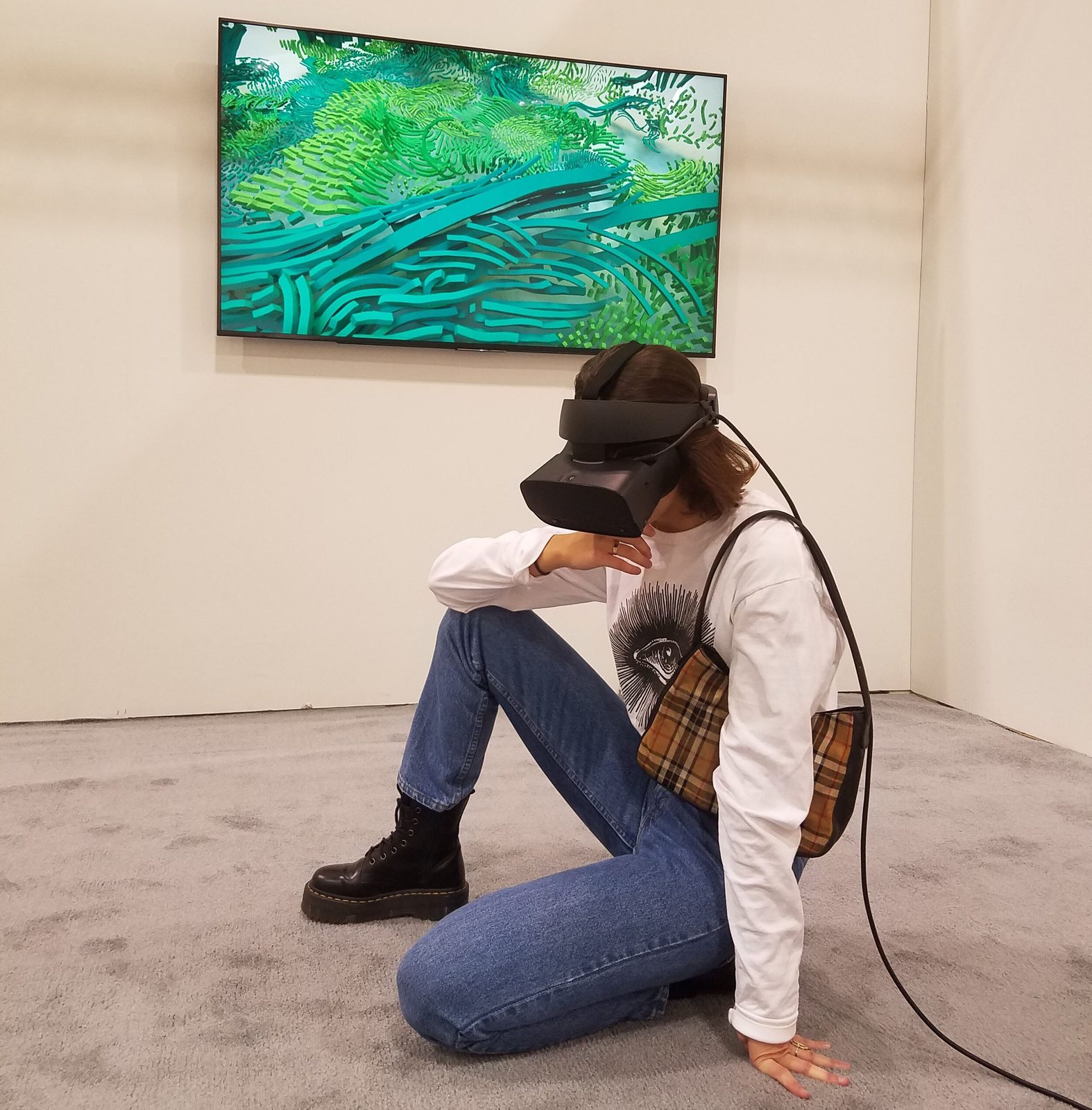
One of the first times a hand-sculpted VR environment was shown at a major Canadian art fair. OASIS turned the convention floor into a meditation garden, and the visitors into performers.
L’une des premières fois qu’un environnement VR sculpté à la main était présenté dans une grande foire d’art canadienne. OASIS a transformé le plancher de la foire en jardin de méditation, et les visiteurs en performeurs.
In October 2019, Galerie ELLEPHANT presented OASIS at Art Toronto, one of Canada’s most prominent contemporary art fairs. The piece, a digital garden prototype originally titled Metaverse Room, places the majority of its sculptural detail on the ground plane: grasses, tendrils, flows, and organic forms that erupt through the floor of a dissolving room.
En octobre 2019, la Galerie ELLEPHANT a présenté OASIS à Art Toronto, l’une des plus importantes foires d’art contemporain au Canada. L’œuvre, un prototype de jardin numérique d’abord intitulé Metaverse Room, concentre l’essentiel de son détail sculptural sur le plan du sol : herbes, vrilles, coulées et formes organiques qui jaillissent à travers le plancher d’une pièce en dissolution.
This design decision had a remarkable social effect. Visitors who entered the VR garden instinctively crouched, sat, or even lay down on the art fair floor, lowering themselves to the level of the virtual grass. In the controlled context of a major art fair, surrounded by hundreds of observers, this became an unexpectedly intimate and disarming act. The spectator, visible to the crowd outside the headset, became the show.
Cette décision de conception a eu un effet social remarquable. Les visiteurs qui entraient dans le jardin VR s’accroupissaient, s’asseyaient ou même s’allongeaient instinctivement sur le plancher de la foire, s’abaissant jusqu’au niveau de l’herbe virtuelle. Dans le contexte contrôlé d’une grande foire d’art, entourés de centaines d’observateurs, ce geste devenait étonnamment intime et désarmant. Le spectateur, visible pour la foule à l’extérieur du casque, devenait le spectacle.
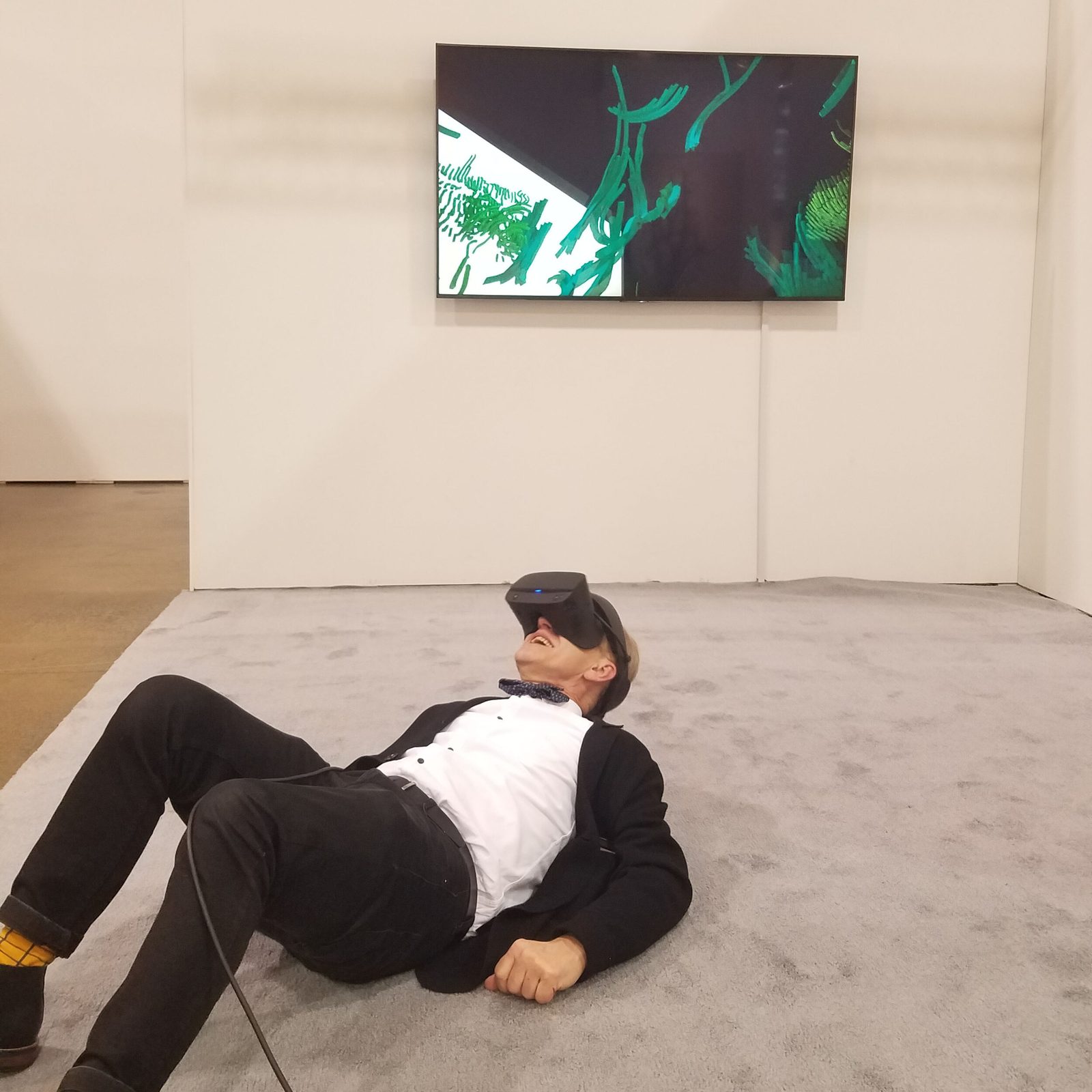
By placing the majority of the detail on the ground, visitors experienced the environment as if sitting in grass. This posture is disarming for many people, especially when being observed in a crowd. Still, many visitors let themselves go during their visit to OASIS.
En plaçant l’essentiel du détail au sol, les visiteurs vivaient l’environnement comme s’ils étaient assis dans l’herbe. Cette posture désarme bien des gens, surtout lorsqu’on est observé dans une foule. Pourtant, de nombreux visiteurs se sont laissés aller pendant leur visite d’OASIS.
Each visitor’s physical posture became a visible index of their engagement with the virtual space. Some sat cross-legged, some knelt, some reached toward the ground. The booth became a stage where the audience outside the headset could watch someone gradually surrender to an invisible world.
La posture de chaque visiteur devenait un indice visible de son engagement avec l’espace virtuel. Certains s’asseyaient en tailleur, d’autres s’agenouillaient, d’autres tendaient la main vers le sol. Le kiosque devenait une scène où le public, à l’extérieur du casque, pouvait regarder quelqu’un s’abandonner peu à peu à un monde invisible.

In the controlled context of a major art fair, surrounded by hundreds of observers, crouching and sitting on the floor became an unexpectedly intimate and disarming act.
Dans le contexte contrôlé d’une grande foire d’art, entouré de centaines d’observateurs, s’accroupir et s’asseoir au sol devenait un geste étonnamment intime et désarmant.

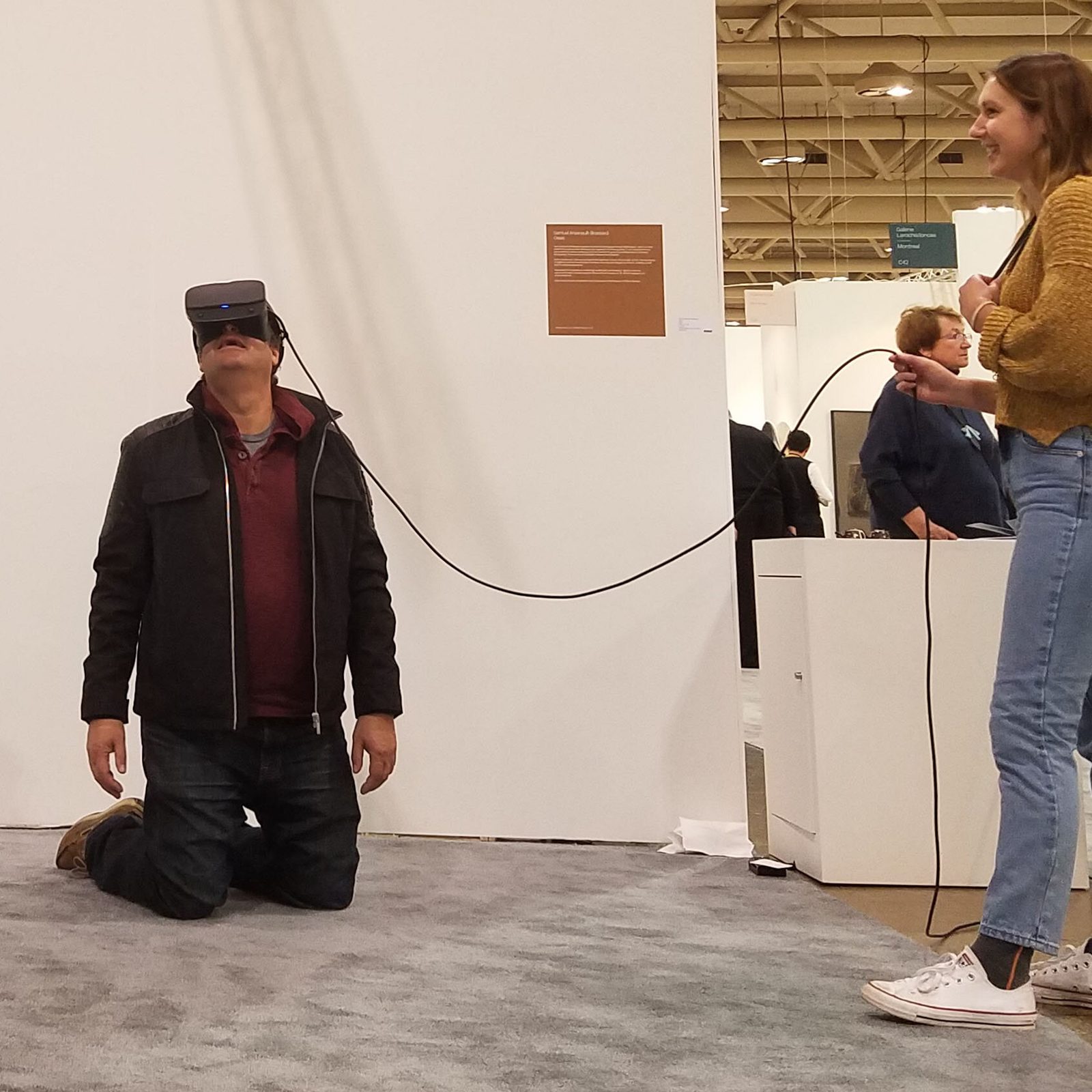
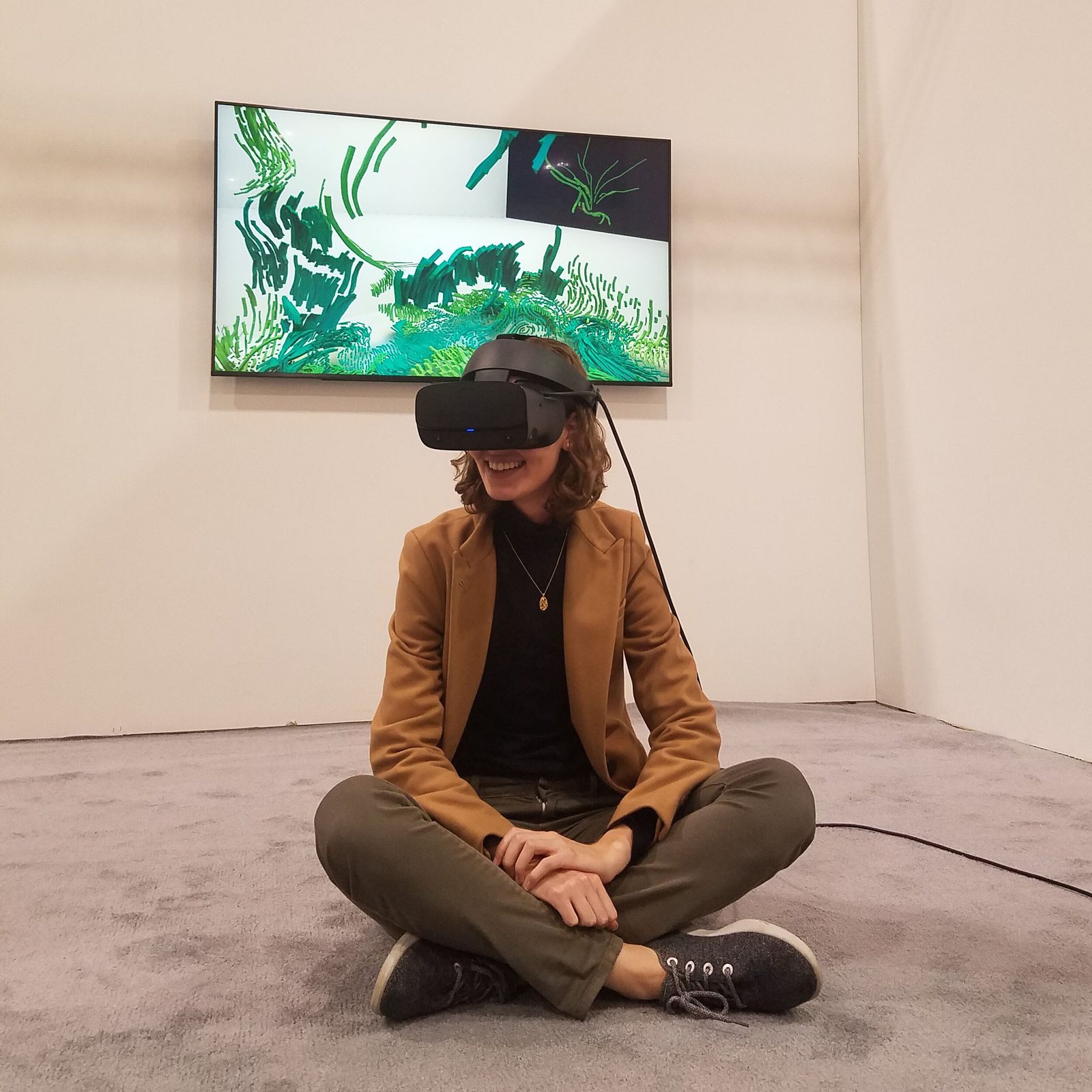
The Art Toronto presentation was significant for several reasons. It demonstrated that a hand-sculpted VR environment could hold its own alongside painting, sculpture, and photography in a major art fair context. It proved that the physical act of experiencing VR, the visible surrender of a person to an invisible world, could itself become a compelling spectacle for observers. And it introduced the custom VR plinth designed for ELLEPHANT, which presented the headset with the material dignity of a gallery object.
La présentation à Art Toronto a marqué les esprits pour plusieurs raisons. Elle a démontré qu’un environnement VR sculpté à la main pouvait tenir tête à la peinture, à la sculpture et à la photographie dans le contexte d’une grande foire d’art. Elle a prouvé que l’acte physique de vivre la VR, l’abandon visible d’une personne à un monde invisible, pouvait devenir lui-même un spectacle captivant pour les observateurs. Et elle a introduit le socle VR sur mesure conçu pour ELLEPHANT, qui présentait le casque avec la dignité matérielle d’un objet de galerie.
The experience at Art Toronto reinforced a conviction that would carry through to Gloam: the most powerful VR art creates conditions for contemplation. Spaces that invite visitors to lower their guard, change their posture, and inhabit a world at a pace the physical world rarely permits.
L’expérience d’Art Toronto a renforcé une conviction qui allait se poursuivre jusqu’à Gloam : l’art VR le plus puissant crée les conditions de la contemplation. Des espaces qui invitent les visiteurs à baisser la garde, à changer de posture et à habiter un monde à un rythme que le monde physique permet rarement.